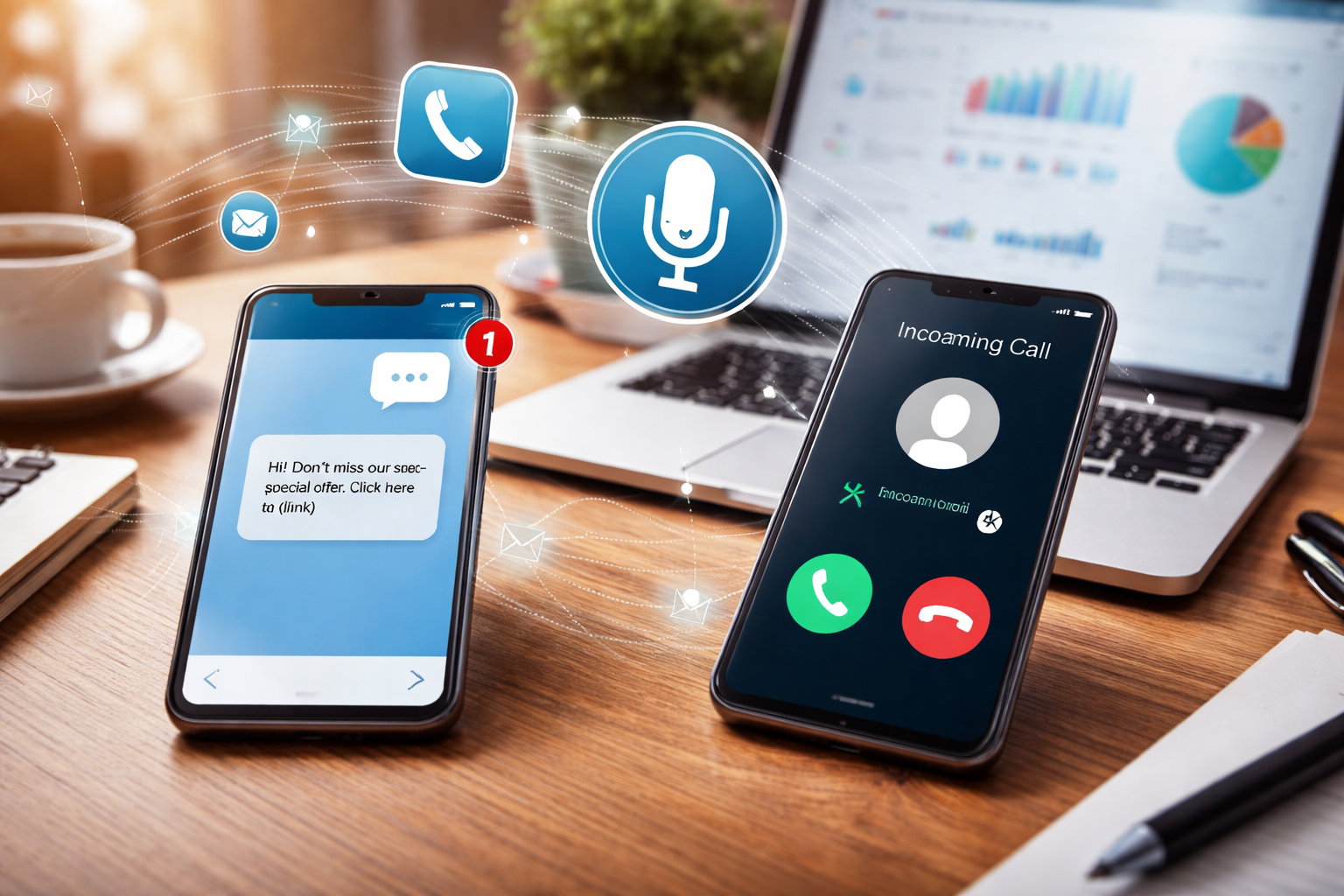
Most businesses treat voice and SMS as separate channels with separate strategies and separate budgets. That’s a missed opportunity. These two channels are more powerful together than either is alone, and the businesses figuring that out are seeing it in their conversion rates.
Voice calls create depth and trust. SMS creates immediacy and action. When both are part of the same campaign, they cover the full range of what it takes to move a customer from attention to decision.
Voice Marketing vs. SMS Marketing: Key Differences Every Business Should Know
Voice marketing focuses on delivering personalized, interactive messages through calls, creating a human connection that builds trust and engagement. In contrast, SMS marketing delivers quick, concise text messages that are easy to read and act on instantly. Together, they offer complementary strengths, voice for impact and SMS for speed, making them essential tools for effective mobile engagement.
Voice marketing involves delivering messages through automated or live phone calls. These can include reminders, promotions, surveys, or personalized outreach. Voice adds a human touch, making communication feel more direct and trustworthy.
SMS marketing, on the other hand, uses text messages to deliver concise, immediate information. It’s ideal for quick updates, promotional alerts, and links to landing pages.
While both operate on mobile devices, their strengths are distinct: voice marketing is personal and engaging, while SMS marketing is quick, direct, and actionable. Understanding this difference is key to leveraging their combined potential.
The Power of Mobile Engagement
Mobile devices are now the primary communication channel for most consumers. With open rates exceeding 90%, SMS marketing ensures your message is seen almost instantly. Voice marketing complements this by adding depth and emotional connection.
When used together, these channels create a seamless communication experience that keeps users engaged at multiple touchpoints. This layered approach significantly enhances mobile engagement, leading to better recall and higher response rates.
The Synergy of Combining Call and Text Campaigns
The real value of integration shows up when voice and SMS are coordinated rather than running in parallel. Here’s how that works in practice:
Reinforcement of Messaging
A voice call can introduce a promotion or important update, while a follow-up SMS provides details or a clickable link. This ensures the message is both heard and easily actionable, with each channel doing the job it does best.
Increased Reach and Accessibility
Not all customers respond the same way. Some prefer listening, while others prefer reading. By combining both, you reach a wider range of preferences and reduce the risk of your message not landing because it came through the wrong channel.
Timely Follow-Ups
A missed call doesn’t have to mean a lost lead. An automated SMS sent immediately after an unanswered call keeps the conversation going and gives the customer an easy way to re-engage on their terms.
Higher Conversion Rates
Voice marketing builds trust, while SMS marketing drives action. Together they create a complete customer journey, from initial awareness through to conversion, without gaps or drop-off points.
Why Integrated Campaigns Convert Better
Personalized Customer Experience
Voice marketing allows for personalized interactions, using the customer’s name or tailoring the message based on past behavior. SMS can then deliver personalized links or offers that reinforce what was said in the call. The combination feels less like marketing and more like a relevant, timely communication from a brand that knows who they’re talking to.
Multi-Touchpoint Strategy
Consumers rarely convert after a single interaction. By combining voice and SMS, brands create multiple touchpoints that guide users through the decision-making process without requiring them to seek out the next step themselves.
Improved Response Rates
Voice messages grab attention, while SMS provides convenience. This combination ensures that users not only notice the message but have an easy, low-friction way to act on it immediately.
Cost-Effective Engagement
Compared to traditional marketing channels, both voice marketing and SMS marketing are highly cost-effective. When integrated, they deliver stronger ROI by ensuring each channel reinforces the other rather than operating at full cost for partial results.
Practical Use Cases Across Industries
- Retail: A voice call announces a flash sale, followed by an SMS with a direct purchase link.
- Healthcare: Appointment reminders via voice calls, with SMS confirmations and rescheduling options.
- Finance: Fraud alerts through voice, supported by SMS instructions for immediate action.
- Events: Invitations via voice call, with SMS tickets or event details.
These examples show how the combination enhances clarity, convenience, and conversion across very different customer contexts. For more on how phone-based campaigns have evolved to support this kind of multi-channel approach, see our post on how phone campaigns evolved from 900 numbers to mobile marketing.
Best Practices for Integrated Voice and SMS Campaigns
Maintain consistency. Voice and SMS messages should align in tone, content, and timing. A customer who receives a voice call about one offer and an SMS about a different one will notice the disconnect.
Time the SMS follow-up carefully. Sending an SMS immediately after a voice call, especially an unanswered one, is one of the highest-converting sequences available. Waiting too long reduces the impact significantly.
Keep voice messages concise. Listeners decide within the first few seconds whether to stay engaged. Get to the value quickly and leave the details to the SMS.
Segment before you send. Personalized campaigns based on customer preferences and past behavior consistently outperform generic blasts. The data you already have about your customers should be informing every message.
Track and optimize. Monitor response rates, call completion rates, SMS click-through rates, and conversion metrics across both channels. The combination of these data points gives you a clearer picture of campaign performance than either channel alone.
Go Deeper on Phone-Based Marketing
Voice and SMS integration is one piece of a broader phone-based marketing strategy that has roots going back further than most people realize. Bob Bentz’s book Opportunity is Calling tells the story of how phone-based performance marketing began with 900 numbers and laid the groundwork for everything that followed. Order it on Amazon or visit bobbentz.com for speaking and consulting inquiries.